
5 Mistakes People Over 40 Make Trying to Build More Willpower (When Your Brain Is Designed to Delete It After 66 Days)
You're not weak. You're fighting the wrong battle entirely.

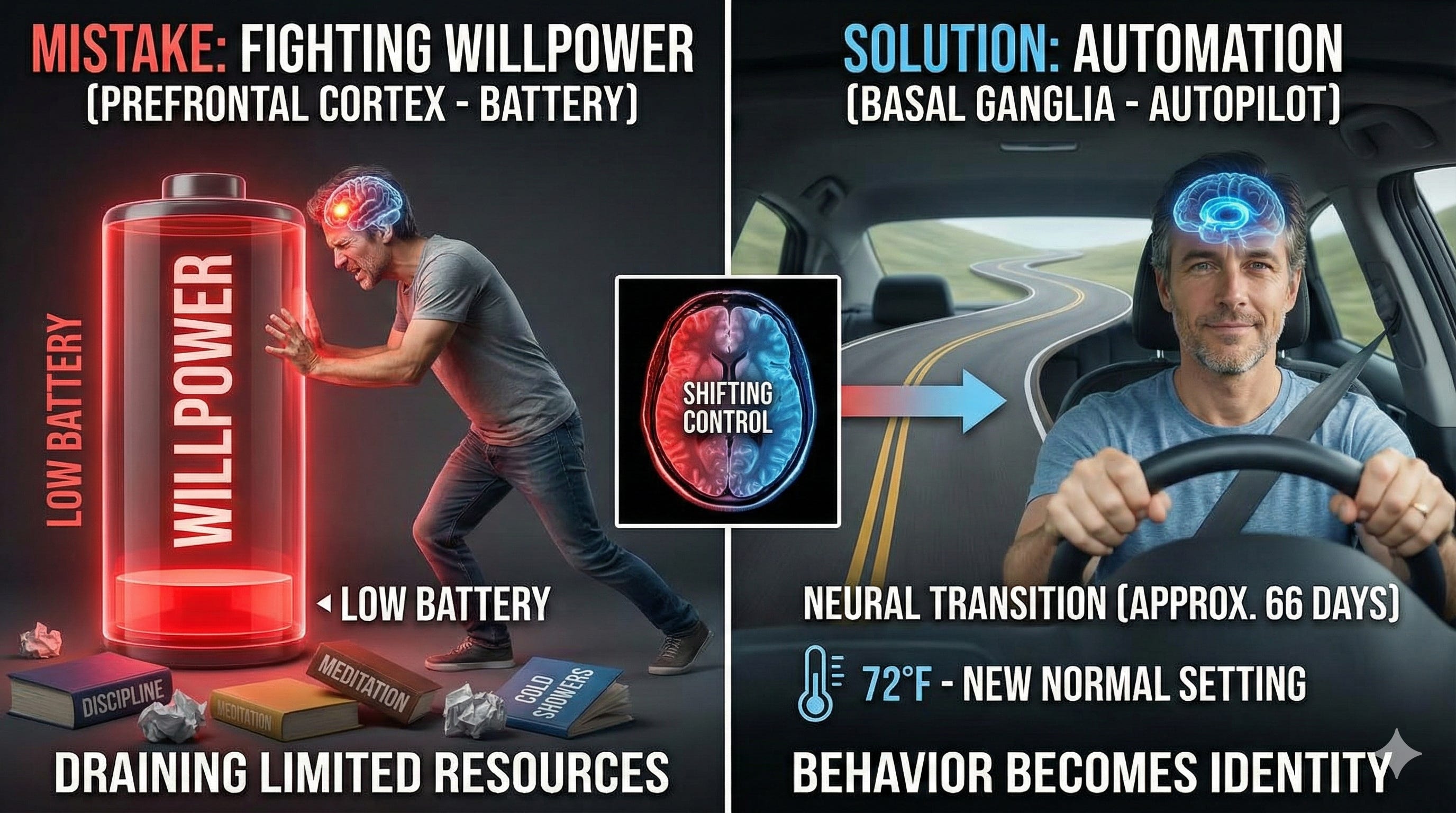
I spent years trying to build stronger willpower.
Meditating. Cold showers. Journaling my “why.” Reading every book on discipline I could find. And yeah, it worked… For about three weeks. Then life happened. Stress hit. The willpower tank emptied. And I found myself failing my diet plan all the time wondering what went wrong.
Again.
Here’s what nobody told me: My brain wasn’t supposed to run on willpower forever. It was supposed to delete willpower from the equation entirely.
That sounds backwards, I know. But stick with me. Because once I understood what was actually happening in my brain, not the motivational poster version, but the actual neuroscience, things began to change.
The Lie We’ve Been Sold About Discipline
The diet industry has convinced us that willpower is a muscle. Train it. Strengthen it. Build more of it.
So we white-knuckle through another diet. We resist the bread basket. We say no to the birthday cake. And we tell ourselves that eventually, this will get easier. That our willpower muscle will get stronger.
But research tells a different story.
Willpower isn’t a muscle that grows. It’s a battery that drains. Your prefrontal cortex, the part of your brain responsible for conscious decision-making and self-control, runs on limited resources. Every decision you make throughout the day depletes it. By 8pm, that battery is running on fumes.
This is why cravings hit hardest at night. It’s not weakness. It’s neurochemistry.
And here’s the interesting part. Your brain is designed to get willpower out of the equation. Not because you’re supposed to give up, but because you’re supposed to transform.
What Actually Happens in Your Brain After 66 Days
Researchers at University College London tracked habit formation and found something fascinating. On average, it takes 66 days for a behavior to become automatic. Though the range stretched from 18 to 254 days depending on the complexity of the behavior and the individual.
But here’s the part that matters. When a behavior becomes automatic, control shifts from your prefrontal cortex(effort) to your basal ganglia(auto).
In normal human terms? The behavior moves from the “trying hard” part of your brain to the “autopilot” part.
Think about driving a car. Remember when you first learned? Every action required conscious thought. Check mirror. Signal. Brake gently. Now you drive home from work and barely remember the trip. Your basal ganglia took over. The behavior became part of who you are, not something you have to force.
That’s supposed to happen with healthy eating too.
The goal isn’t stronger willpower. The goal is making willpower irrelevant.
Mistake #1: You’re Strengthening the Wrong System
When you try to build more willpower, you’re essentially trying to make your prefrontal cortex work harder and longer. But that’s like trying to make your phone battery last all week by wanting it really badly.
Willpower depletion is real. Decision fatigue is real. And the more you rely on conscious effort to make food choices, the more vulnerable you are when that effort runs out.
The fix isn’t a stronger prefrontal cortex. It’s transitioning behavior to the basal ganglia, where it runs automatically, without conscious effort, without draining your limited daily resources.
This is why people who’ve maintained weight loss for 2-5 years report that it gets easier, not harder. They’re not more disciplined than you. They’ve completed the neural transition. The behavior runs on autopilot now.
But you can’t skip the messy middle. And you definitely can’t shortcut it by trying harder.
Mistake #2: You’re Measuring Success by How Hard You’re Trying
I used to think struggle was proof I was doing it right. If it was hard, I was being disciplined. If it was easy, I must be cheating somehow.
Completely backwards.
If you’re still white-knuckling it after months, that’s not evidence of commitment. That’s evidence that the transformation hasn’t completed.
Real transformation feels different. It’s not gritting your teeth at the dessert table. It’s looking at the dessert table and genuinely not caring that much. Not because you’re denying yourself, but because the internal negotiation has stopped.
The goal is silence. A quiet mind around food. And you don’t get there by fighting harder. You get there by becoming someone for whom that fight doesn’t exist.
Mistake #3: You’re Fighting Your Identity Instead of Shifting It
Here’s what took me way too long to figure out.
Your brain has something like a thermostat for your weight. An internal set point that feels “normal.” And just like a house thermostat, it doesn’t matter how many windows you open, if the thermostat is set to 72, the furnace fires up and brings it back.
Diets are open windows. They temporarily change the temperature. But if your internal thermostat, your identity, is still set to “person who struggles with food,” you’ll drift back. Every time.
You can’t willpower your way past a thermostat setting. The thermostat always wins.
This is why two people can follow the exact same diet and get completely different results. One person loses weight and keeps it off. The other loses the same weight and gains it back plus ten pounds. The difference isn’t discipline. It’s whether the thermostat shifted.
The question isn’t “how do I resist food better?” The question is “who do I need to become so that resistance isn’t required?”
Mistake #4: You Think Missing Days Ruins Everything
One of the most liberating findings from habit research: missing an occasional day doesn’t derail the process.
The myth of the “streak” has done tremendous damage. One slip and people throw in the towel. “Well, I already ruined today, might as well finish the pizza.” Sound familiar?
But the neuroscience shows that consistency over time matters far more than perfection in any given moment. Your basal ganglia doesn’t care about one bad Tuesday. It’s looking at the overall pattern across weeks and months.
This is scientists-not-judges thinking. When you slip, you’re not collecting evidence of failure. You’re collecting data about triggers. What happened? What preceded it? Interesting. Now what can you learn?
The person who eats perfectly for three weeks then quits after one bad night will never transform. The person who eats imperfectly but keeps showing up for six months will.
Consistency beats intensity. Every time.
Mistake #5: You’re Waiting to Feel Like a Different Person Before Acting Like One
Research on narrative identity found something that seems backwards at first: people who successfully change don’t feel different first and then act different. They act different first, and the feelings follow.
You don’t wait until you feel like someone who exercises to start exercising. You start exercising, and eventually you become someone who exercises. The agency precedes the change.
This is what researchers call “living your way into” a new identity. You author a new story about who you are, then you act as if it’s already true. Not fake it till you make it. More like practice the identity until it becomes automatic.
Your brain is watching. When you consistently act like someone who takes care of their body, your brain starts building the neural architecture to support that identity. The basal ganglia starts taking over. The behavior becomes default.
But it starts with acting from the new identity before it feels natural. Before you “feel like it.” Before the transformation is complete.
What This Means for You
If you’re over 40 and you’ve tried everything, I want you to hear this clearly:
You were never broken. You were fighting the wrong battle.
Willpower was never going to save you. It was always going to run out—because that’s what willpower does. The goal was never to build a bigger willpower tank. The goal was to transition to a system that doesn’t need willpower at all.
That transition is real. It’s measurable. Neuroscientists can see it happening in brain scans. And it takes time—not 21 days, but somewhere between 18 and 254 days depending on you and what you’re changing.
The path forward isn’t trying harder. It’s becoming different.
Not “becoming different someday when the transformation is complete.” Becoming different now, in how you see yourself, in the story you tell about who you are. Acting from that identity even when it feels awkward. Especially when it feels awkward.
And trusting that if you stay consistent—not perfect, consistent—your brain will do what it’s designed to do. It will automate the behavior. It will shift control to the basal ganglia. It will make willpower irrelevant.
That’s not wishful thinking. That’s neuroscience.
The question isn’t whether your brain can make this shift. It can. The question is whether you’ll stop trying to strengthen willpower long enough to let the real transformation happen.
Ready to stop fighting your brain and start working with it? The Circuit Breaker Protocol gives you the exact tool I use to interrupt the craving cycle while your identity catches up. It’s free, it works, and it might be the last “willpower hack” you ever need—because it’s designed to make willpower obsolete. Subscribe now to get it!
References
Lally, P., van Jaarsveld, C. H. M., Potts, H. W. W., & Wardle, J. (2010). How are habits formed: Modelling habit formation in the real world. European Journal of Social Psychology, 40(6), 998-1009. https://doi.org/10.1002/ejsp.674 — The landmark study establishing the 66-day average (range 18-254 days) for habit automaticity.
Graybiel, A. M. (2008). Habits, Rituals, and the Evaluative Brain. Annual Review of Neuroscience, 31, 359-387. https://doi.org/10.1146/annurev.neuro.29.051605.112851 — MIT research on basal ganglia’s role in habit formation and the “chunking” of automatic behaviors.
Baumeister, R. F., & Tierney, J. (2011). Willpower: Rediscovering the Greatest Human Strength. Penguin Press. — Comprehensive review of ego depletion and willpower as a limited resource.
Max Planck Institute for Human Cognitive and Brain Sciences. Research on structural brain plasticity and the medial prefrontal cortex’s role in self-referential processing. https://www.mpg.de/brain — Evidence that identity changes produce measurable structural changes in the brain.
National Weight Control Registry. Long-term weight loss maintenance research showing improved success rates after 2-5 years of maintenance.
http://www.nwcr.ws/ — Database tracking individuals who have maintained 30+ pound weight loss for over a year.
Duhigg, C. (2012). The Power of Habit: Why We Do What We Do in Life and Business. Random House. — Popularized understanding of the habit loop (cue-routine-reward) and the “golden rule” of habit change.
McAdams, D. P., & McLean, K. C. (2013). Narrative Identity. Current Directions in Psychological Science, 22(3), 233-238. https://doi.org/10.1177/0963721413475622 — Research showing agency themes in personal narratives predict psychological wellbeing and precede behavioral change.